


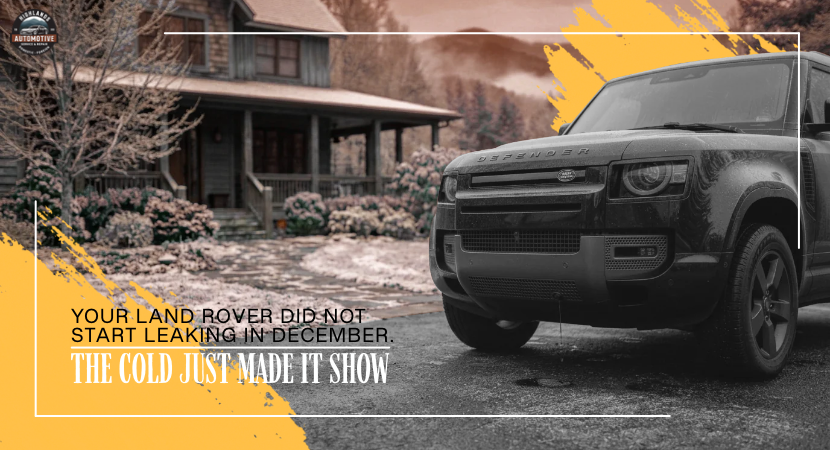
Nothing on the car changed. Nobody worked on it, nothing was hit, and it was dry on the driveway through the fall. Then a hard freeze settles over the plateau, and by the second week there is a spot on the concrete under the front of the engine that gets a little bigger every morning.
What changed is the weather, and it changed three things at once. Every one of them turns a joint that was weeping into a joint that is dripping.
Cold oil is thicker, and thick oil pushes harder
Oil viscosity climbs steeply as temperature falls. At the moment of a cold start the pump is trying to move a fluid several times thicker than the one it moved yesterday afternoon, and the pressure relief valve holds the system at its maximum setting for far longer than it would on a warm morning.
Higher pressure for longer, against a gasket that was already marginal, is enough on its own. It is why so many of these leaks are worst in the first two or three minutes and then settle down, and why owners often describe finding a fresh spot after the car has been started and moved, not after a long drive.
Up here that sequence happens more often and more sharply than it does down the mountain. Highlands sits above four thousand feet, so a car parked outside starts its morning at a temperature that would be unusual for the same car in the valley.
Rubber shrinks and hardens, and that is where the gap comes from
A gasket seals because it is elastic enough to fill an imperfect joint. Cold takes some of that away. Nitrile and silicone seals both lose flexibility as the temperature drops, and an old seal that has already hardened chemically from years of heat cycling has very little compliance left to lose.
Aluminum shrinks too, and faster than steel, so the clamping load across a cover or a pan joint changes as the metal contracts. On the V6 and V8 engines in Range Rover, Discovery and the Jaguar lineup, the places that show it first are the timing cover seam, the valve cover edges, the oil filter housing seal and the front crankshaft seal.
None of that is a reason to panic and replace every gasket on the engine. It is a reason to take the first winter drip seriously, because the seal that moved in December will not move back on its own in April.
The oil you put in matters more in a cold climate
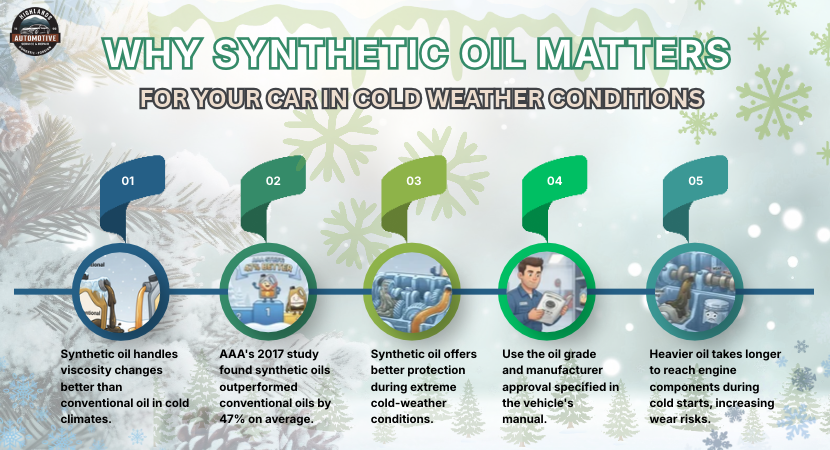
A good synthetic resists the viscosity swing better than a conventional oil does, and on a mountain that difference shows up every morning. AAA’s 2017 engine oil study found that synthetic oils outperformed conventional oils in the conducted tests by 47 percent on average, and it names extreme hot or cold climates among the conditions where drivers should consider synthetic.
These engines are specified for synthetic anyway, so for most owners the real decision is narrower: use the grade and the manufacturer approval the manual lists, and do not reach for something heavier because it feels like it will leak less. A heavier oil takes longer to reach the top of the engine on a cold start, which costs you wear in exactly the conditions you were worried about.
What we do with a car that has started dripping
The first visit is about identifying the joint, and that means degreasing the underside and the front of the engine, running the car, and looking again with a light. On a car that only drips when cold, we will often want it left overnight so the first start of the day happens here and not in your driveway.
Once the source is confirmed, the repair gets scoped honestly. Some of these are a two-hour gasket. Some, like a timing cover on a supercharged V8, are a day of work, and in that case the right conversation is about what else is worth doing while the front of the engine is open rather than pretending the job is small.
Frequently Asked Questions
Q: Should I worry about a few drops a day?
A: Watch the level and have the source identified. A few drops a day rarely strands anybody, and the same joint usually gets worse once it has started.
Q: Will the leak stop on its own when the weather warms up?
A: The dripping often slows in spring, and that is why these go unrepaired for years. The seal has still failed and the oil is still going somewhere.
Q: Is there an additive that swells seals and fixes this?
A: Those products soften rubber across the whole engine, including seals that are doing their job. We would not put one in a car we expected to keep.
A Cold Morning Appointment Shows Us the Most
If there is a new spot under your car, let us find the joint it is coming from before the winter does any more work on it.
Highlands Automotive Service and Repair — 2851 Cashiers Rd, Highlands, NC 28741