


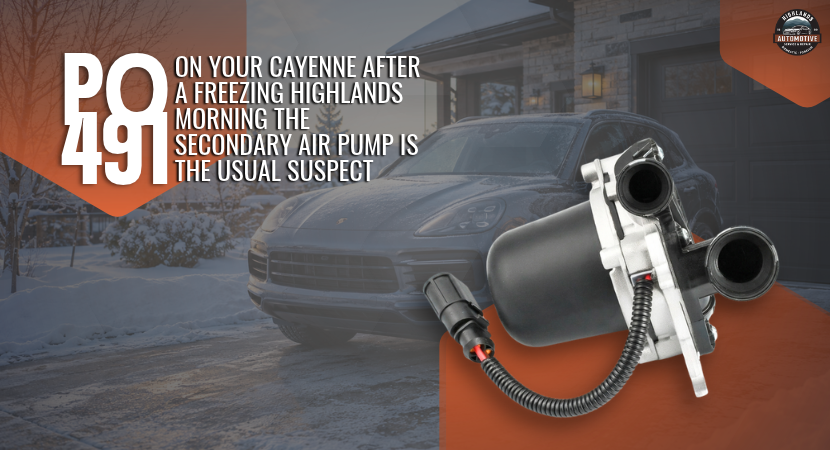
Code P0491 tells you the secondary air system on bank 1 moved less air than the engine computer expected during a cold start. On a Porsche Cayenne in Highlands, the electric air pump is the first part to test, though a sticking valve or a cracked vacuum line can set the same code. November adds near-freezing air to every first start of the day. The car still drives. But a lit check engine light also hides whatever fault comes next, so it pays to trace this one before the holiday visits pile up.
Quick Summary: Key Takeaways
- What the code means: the engine computer measured too little secondary air on bank 1 during its cold-start check; P0492 is the same fault on bank 2.
- Why winter brings it out: the test only runs right after a cold start, and in November that first start of the day comes in near-freezing air.
- Where to look: the pump comes first, with the valves and their vacuum hoses close behind.
- The cost of waiting: a steady light is not an emergency, but it masks any new fault that sets afterward.
P0491 Means the Secondary Air System Moved Too Little Air
P0491 is a flow fault, not a sensor fault. For a short window after a cold start, a secondary air injection pump blows fresh air into the exhaust so the catalytic converters heat up sooner. Valves on the exhaust side open to let that air in.
Then the computer checks. P0491 is a generic OBD-II code, so its meaning doesn’t change from make to make. The clearest published factory description of the test comes from Audi, and it covers only the 2010–2012 A8 4.2 FSI: the low-flow codes set while the engine is still in its cold-start phase, when the solenoid valves are switched on and the secondary air pressure is compared against a specified value. That bulletin covers an Audi sedan, not the Cayenne, and it only shows how such a test is graded.
The Cold-Start Test Runs on the First Start of a Highlands Morning
The secondary air system only works right after a cold start. A quick restart on a warm engine skips it entirely, so the first start of the day is the one that counts.
In a Highlands November, that first start happens in near-freezing air on Cashiers Road, and the pump has to come up to speed cold before the computer grades it. A Cayenne parked at a mountain house between Thanksgiving and Christmas visits gets that test the moment someone turns the key.
A pump that just scraped by on mild mornings can fall short on a frosty one, and that is often when the lamp appears.
The Pump Is First in Line, but It Has Company
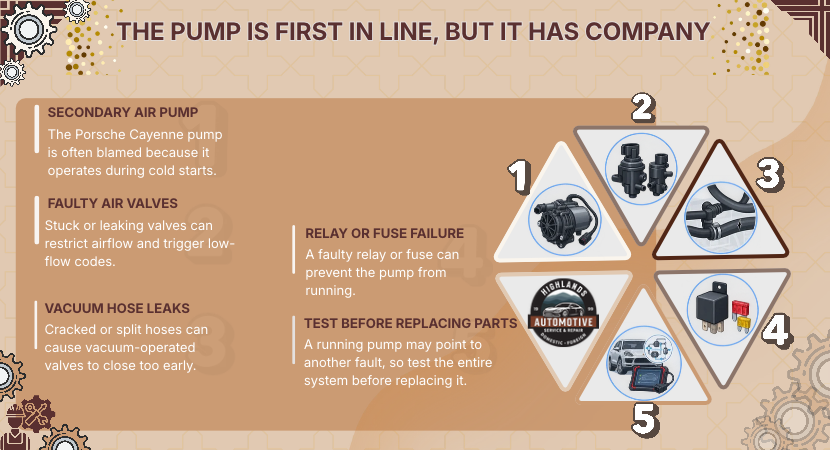
The Porsche Cayenne secondary air pump gets blamed first because it is the moving part, and every one of its short runs happens in the coldest conditions the engine sees.
It is not the only suspect, though. On the A8, Audi traced the same low-flow codes to vacuum leaks that let the valves close too early, and its production fix was improved combination valves, not a new pump. That bulletin doesn’t cover the Cayenne. What carries over is the lesson: a low-flow code describes the whole system, so the whole system gets tested. On a typical secondary air setup, the list runs like this:
- A pump that is silent or noisy on a cold start
- Air valves stuck shut or leaking
- Cracked or split vacuum hoses, where the valves are vacuum-operated
- A relay or fuse that never lets the pump run
Replacing a good pump because the code says “air” is the expensive mistake. A running pump points elsewhere.
A Steady Light Is Safe to Drive, but It Hides the Next Fault
You can keep driving on a solid light from P0491 for a while. The engine runs normally once warm, and the missing air affects cold-start emissions rather than engine wear.
The real cost is what the lamp can no longer tell you. With the lamp already lit, a fuel-trim fault or a failing sensor that sets next week adds no new warning, because a steady light can’t get any brighter.
Inspections matter too, depending on where the Cayenne is registered. As of 2026, North Carolina requires an on-board diagnostic emissions inspection in 19 counties, and the list includes Buncombe but not Macon or Jackson, so a car registered in Macon or Jackson County faces only the safety check while one registered in Buncombe faces both. Vehicles 20 years old or older are exempt from the emissions portion.
How a P0491 Gets Traced at Highlands Automotive
The diagnosis starts cold. Highlands Automotive, the family-owned NAPA AutoCare shop on Cashiers Road, reads Porsche faults with Durametric, the Porsche-specific diagnostic software the shop connects through the OBD-II port to read stored codes.
Then comes component testing. The shop’s Porsche diagnostic process includes activating specific components and watching live data. A technician can listen for the pump on a cold start, check the vacuum hoses and compare readings, which separates a dead pump from a stuck valve or a leaking hose before any part is ordered.
You get a detailed estimate before any work starts. Repairs use OEM parts.
Frequently Asked Questions
Q: Can I drive my Porsche Cayenne with code P0491?
A: Yes, briefly. If the light is steady and the car runs normally, local trips are fine, but get it checked soon, because the lit lamp will not warn you about a second fault that sets later.
Q: What is the difference between P0491 and P0411?
A: P0491 means the secondary air system delivered too little air on bank 1. P0411 means the flow was incorrect overall. Both point to the same pump, valves and vacuum lines, and both call for testing those parts rather than guessing.
Q: Why does P0491 come back after the code is cleared?
A: Clearing the code resets the lamp, not the hardware. The next cold start repeats the test, and if the pump or a valve is still weak, the code returns.
Leave the Cayenne Overnight for a True Cold Start
Bring the Cayenne in cold, since that is the only time the secondary air system runs. Night drop is available at 2851 Cashiers Rd, Highlands, NC 28741, so the SUV can sit overnight on the lot and be properly cold for its first start the next day. Mention the P0491 on the booking form at highlandsautomotive.com, along with whether a P0492 or P0411 showed up beside it.