



US-64 out of Franklin climbs roughly 2,000 feet before you reach town. Your Land Rover feels every foot of it. Coolant temps creep, the transmission shifts more in ten miles than a flat commute asks in fifty, and the air suspension keeps correcting over broken pavement and gravel drives.
Highlands sits at 4,118 feet. Cars kept up here need service timed to the terrain, not to a generic chart written for interstate miles. August heat stacked on steep grade finds a tired water pump, a leaking air spring, or transfer case fluid that should have been changed two years ago.
Quick Summary: Key Takeaways
- Elevation changes the math: at 4,118 feet, engine and transmission cooling work harder here than they ever do in Asheville traffic.
- Coolant is the priority: on the 5.0-liter supercharged V8, plastic crossover pipes and the thermostat housing start weeping past 70,000 miles.
- Air suspension shows wear early: a Range Rover that sags overnight needs a leak test, not another compressor reset.
- Shorten the fluid intervals: transfer case and differential fluid every 45,000 miles, brake fluid every two years, oil at 7,500 miles.
- Tires deserve monthly checks: underinflation plus loaded switchbacks is how sidewalls and wheels get ruined on gravel.
Mountain miles wear a Land Rover on a different schedule
Grade is the difference. Every mile on NC-106 or through the Cullasaja Gorge asks the drivetrain to make power going up, hold the car coming down, and shed heat the whole time. That combination wears cooling, brake and suspension parts on a timeline the factory maintenance chart, written for flat suburban commuting, was never built to predict.
Owners here also pile up short trips. Town, the grocery run, Cashiers and back. Short drives never fully cook moisture out of the oil or the brake fluid, so we pull the intervals in: oil at 7,500 miles rather than 10,000, brake fluid every two years, no argument.
The warning signs local owners bring us most
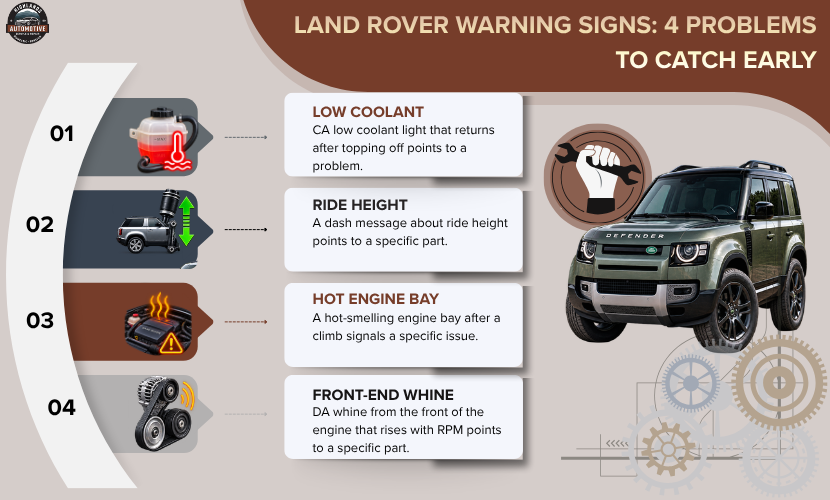
Four symptoms account for most of our Land Rover work. A low coolant light that returns a week after topping off. A dash message about ride height. A hot-smelling engine bay after a climb. And a whine from the front of the engine that rises with rpm.
None of those are mysteries. Each one points at a specific part, and each one gets cheaper the earlier you catch it. A weeping water pump replaced on a Tuesday costs a fraction of an overheated supercharged V8 towed off the Blue Ridge Parkway on a Saturday afternoon. Don’t wait it out.
Cooling system parts fail first on steep, hot climbs
Heat is the enemy up here. On the 5.0-liter supercharged V8, plastic coolant crossover pipes and the thermostat housing start weeping past 70,000 miles. A slow leak you shrug off in June becomes a no-drive tow on the climb toward Whiteside Mountain in August, usually on the hottest afternoon of the month.
The Td6 diesel and 3.0 supercharged V6 have their own tells: pink or orange crust around the water pump pulley, or a coolant level that keeps dropping with no puddle on the floor. Both mean the pump seal is going. Pressure-test it, don’t guess.
Air suspension takes the beating on gravel and switchbacks
Air suspension suffers most from these roads. Constant ride-height correction over frost heaves and gravel drives runs the compressor far harder than highway cruising does. Air springs are rubber, and rubber ages faster in heat and UV, so a set that lasted twelve years in Ohio might give you eight up here in the sun.
Tires matter as much as the springs. NHTSA reports that a tire underinflated by 25 percent or more is about three times as likely to be involved in a crash. On a loaded Discovery pointed down a wet grade, that stops being a statistic. Check pressures cold, monthly.
Deferred fluid service costs the most at this elevation
Skipping fluid changes is the expensive choice. Transfer case and differential fluid on a Discovery or LR4 that climbs daily is a 45,000-mile item in our book, not the lifetime fill the maintenance schedule implies. The ZF 8HP transmission also does better with a drain-and-fill around 60,000 miles. Fresh fluid is cheap.
Run the numbers. A transfer case service costs a few hundred dollars, while a chain-driven transfer case that eats itself runs well into four figures with labor. Coolant works the same way. Flush it on schedule and the water pump, thermostat and heater core all last longer.
Our Cashiers Road shop sets Land Rovers up for local roads
Local knowledge changes the checklist. Because we see the same failures on the same roads, a Land Rover inspection here includes ride-height calibration, a cooling system pressure test, brake fluid moisture readings and a look at the transfer case before you leave for a long weekend. Estimates come in writing.
Night drops help if your only free window is after five. Highlands Automotive has been family-owned since 2009 and it is a NAPA AutoCare facility, so warranty coverage travels with you if something goes wrong away from home. Bring the truck in before the noise gets worse.
Frequently Asked Questions
Q: How often should a Land Rover be serviced if I drive in the mountains?
A: Shorten every interval. Oil at 7,500 miles, brake fluid every two years, transfer case and differential fluid around 45,000 miles, and a cooling system inspection annually. Steep grades and short trips push a Land Rover harder than the factory chart assumes.
Q: Why does my Range Rover sit low overnight?
A: Usually a leaking air spring or a failing valve block, sometimes a worn compressor covering for the leak. A ride-height fault that clears once you drive still points at a leak. Get it tested before the compressor burns out.
Q: Do you work on Land Rover and Range Rover in Highlands, NC?
A: Yes. Land Rover is one of the European brands we service, alongside Audi, BMW, Jaguar, Mercedes, Mini, Porsche and Volvo. We also handle domestic, import and Tesla vehicles at the Cashiers Road shop.
Q: Is it safe to drive a Land Rover with a small coolant leak?
A: No. On a supercharged engine, a small loss turns into overheating fast on a climb, and overheating one of these V8s gets expensive quickly. Top it off, then get it in the same week for a pressure test.
Book Land Rover service before your next mountain trip
Heat, grade and gravel are hard on these trucks. Have the cooling system, air suspension and fluids checked now instead of after a breakdown on US-64.
Highlands Automotive Service and Repair — 2851 Cashiers Rd, Highlands, NC 28741
Hours: Mon–Fri 8:00 AM–5:00 PM; Sat–Sun closed (night drops available)
Website: highlandsautomotive.com