


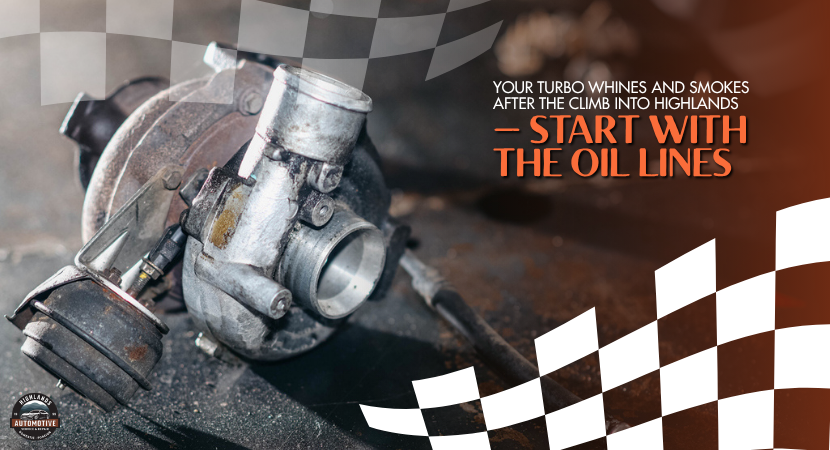
Twenty minutes of steady climbing on US-64, then you park on Main Street and shut it off. Next morning it breathes a puff of blue at startup, and past Cashiers a faint whine rises with boost. Nothing dramatic happened. The oil simply cooked where it sat.
A turbocharger survives on a pencil-thin stream of engine oil, and mountain driving is the hardest thing you can ask of that stream. Highlands Automotive on Cashiers Road is a family-owned NAPA AutoCare shop covering eight European marques plus Tesla, and October is when these calls start — leaf-season traffic means long pulls, a hot shutdown at the top, then a cold start the next morning. Wait too long and the bearing decides the repair for you.
Quick Summary: Key Takeaways
- What coking is: hard carbon left behind when oil bakes inside a hot turbo instead of draining away.
- Where it starts: the feed line’s restrictor orifice, which is narrow enough that a thin film chokes it.
- The early signs: a whine that rises with boost, blue smoke at cold start, and oil loss with no puddle.
- Why these roads matter: a sustained climb leaves the turbine housing at its hottest right as you switch off.
- The cheap fix has a deadline: lines and an oil service cost a fraction of a turbocharger.
A turbocharger lives on a pencil-thin stream of oil
Oil does two jobs inside a turbo. It lubricates the shaft bearings, and it carries heat out of a center housing bolted directly to the exhaust.
Pressurized oil arrives through a small feed line with a restrictor orifice often no wider than a drill bit, then leaves by gravity through a fatter return line into the sump. Gravity is the word that matters. Nothing pumps that oil back out, so anything narrowing the drain pushes oil past the seals at both ends of the shaft.
Small parts. Big consequences.
Shutting off hot at the top of the grade is what bakes the oil
Coking happens after you park, not while you drive. Running, the oil keeps moving and keeps the center housing somewhere near its own temperature.
Kill the ignition at the end of a long pull and that flow stops in an instant while the turbine side is still glowing, so the oil trapped in the feed line and the bearing housing sits against the heat with nowhere to go and leaves a thin skin of carbon behind on the passage walls.
Repeat it through a season of trips up from Franklin and the orifice that once passed a healthy stream now passes a trickle. Main Street in Highlands sits at an elevation of 3,850 feet, and every one of those feet is earned on a grade.
The symptoms arrive in a fairly predictable order
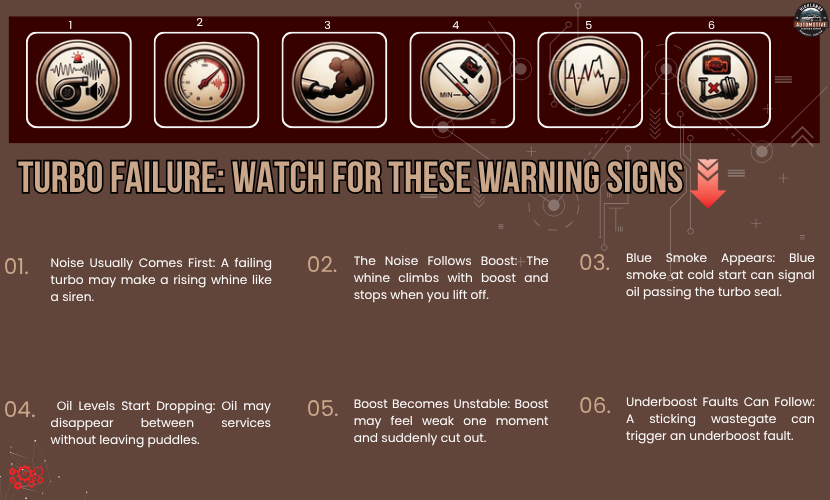
Noise usually comes first. A healthy turbo makes a smooth rush of air; a starved one makes a rising whine, closer to a siren, that climbs with boost and vanishes the second you lift off.
Then the smoke. Blue at cold start means oil is slipping past a shaft seal, and it burns off quickly enough that you may only catch it in the mirror once. Later the dipstick starts dropping between services with no puddle on the driveway to explain it.
Boost turns odd near the end. Soft one minute, then a hard cut with a stored underboost fault, because the wastegate is fighting a shaft that no longer spins free.
Mountain routes into Highlands are harder on a turbo than flat-country driving
The route matters more than the odometer. A turbo loafing along a flat interstate barely works; a turbo climbing for twenty minutes at 3,000 rpm runs near its ceiling the entire way.
US-64 out of the Cullasaja Gorge, NC-106 up from Dillard, the roll over from Cashiers — each one asks for sustained load instead of a quick burst, and sustained load is what drives real heat into the turbine housing. Load the car for leaf season, hook up a trailer, or simply refuse to lift, and it reaches the top hotter than any flat commute would leave it.
Then everyone does the same thing. Park. Shut it off. Walk to dinner.
Oil choice and change interval decide how long the passages stay clear
Two things keep a feed line open: oil that resists cooking, and changing it before it stops resisting. Neither is glamorous.
AAA’s 2017 engine-oil research found synthetic oils performed an average of 47 percent better than conventional oils across eight industry-standard ASTM tests, and AAA lists turbocharged engines among the vehicles that benefit particularly from the switch.
Match the manufacturer approval code printed on the bottle, not just the viscosity, and treat a long-life interval as a ceiling rather than a target if you drive these grades weekly. Short trips, cold starts and steep climbs are what the manual files under severe service. One October week here hands you all three.
The lines get checked before anyone condemns the turbocharger
A whining turbo is not automatically a dead turbo. Lines come off first, because they are cheap and because they are usually the cause.
That means pulling the feed line to look at the restrictor, dropping the return to see whether it runs clean or oozes, and checking the shaft for play and the compressor wheel for an oil film. Stored faults get read the same visit, since a boost deviation that shows only under load points somewhere different than one that never clears.
Choked passages and a tight shaft? New lines plus an oil service put it right. If the bearing has already run dry you will hear that straight from us, because fresh lines on a worn turbo buy a few months and nothing more.
Frequently Asked Questions
Q: What causes a turbo oil feed line to clog?
A: Carbon. Oil left in the line after a hot shutdown bakes onto the passage walls, and the restrictor orifice is small enough that a thin layer chokes the flow. Stretched oil intervals and the wrong oil specification both speed it up.
Q: Can a blocked turbo oil return line cause blue smoke?
A: Yes, and it is one of the more common causes. The return drains by gravity, so once it silts up, oil backs into the center housing and gets forced past the shaft seals. Replacing seals without clearing the drain repeats the failure.
Q: Should you let a turbo engine idle before shutting it off?
A: After a hard pull up a grade, yes. Roughly thirty seconds of idle moves heat out of the turbine housing while oil is still circulating, which is exactly the window coking exploits. After gentle town driving it makes very little difference.
Q: Is a whining turbo always a sign it needs replacing?
A: No. A rising whine often traces back to restricted oil supply, a split intake boot, or a loose clamp ahead of the compressor. Shaft play and oil on the compressor wheel are what separate a supply problem from a worn unit.
Get the oil lines checked at Highlands Automotive
Came up the mountain hot, and whining or smoking since? Don’t let the bearing make the decision for you. Bring it to Cashiers Road.
Hours: Mon–Fri 8:00 AM – 5:00 PM; Sat–Sun closed, night drops available
Website: highlandsautomotive.com