


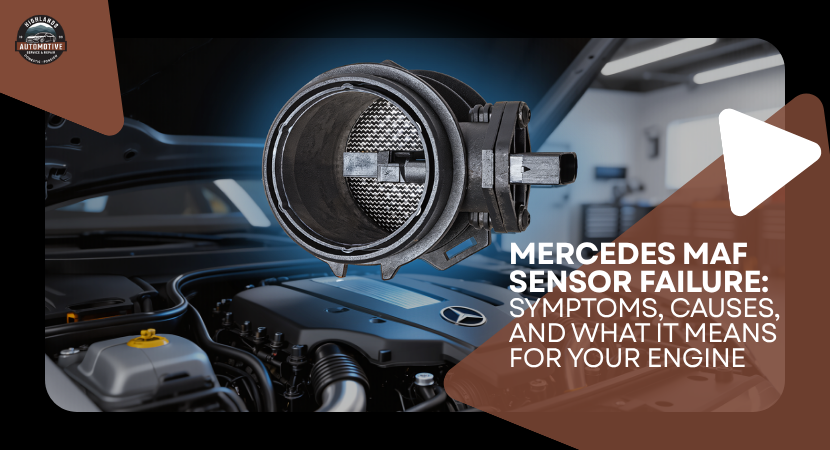
The Mass Air Flow (MAF) sensor is one of the most important inputs to your Mercedes-Benz’s engine management system. Every fuel injection calculation — how much fuel to inject, when to inject it, and how to adjust for changing driving conditions — depends on accurate data from this sensor. When the MAF fails or begins providing inaccurate readings, the engine control unit operates on bad information, and the consequences range from poor fuel economy and sluggish performance to rough idle and failed emissions tests. At Highlands Automotive in Highlands, NC, we see MAF-related issues across a wide range of Mercedes models and generations, and early diagnosis consistently leads to simpler, less expensive repairs.
What the MAF Sensor Does
The MAF sensor sits in the intake air path, typically between the air filter housing and the throttle body. It measures the mass of air entering the engine — specifically, it detects how fast the air is moving and how dense it is at any given moment. This information is fed to the ECU continuously, allowing the fuel injection system to calculate the correct air-fuel ratio for current conditions.
Mercedes uses hot-wire MAF sensors in most of its modern engines. A thin platinum wire is suspended in the airflow and heated to a specific temperature by a precisely controlled electrical current. As air flows past the wire, it cools it proportionally to the air mass. The control circuit compensates by increasing current to maintain the wire temperature, and that current measurement is what the ECU reads as air mass flow. This design is accurate and responsive, but it also means the sensor wire is susceptible to contamination from oil vapors, fine dust, and fuel residue that gradually coat the wire and alter its thermal properties.
Common Symptoms of MAF Failure on Mercedes
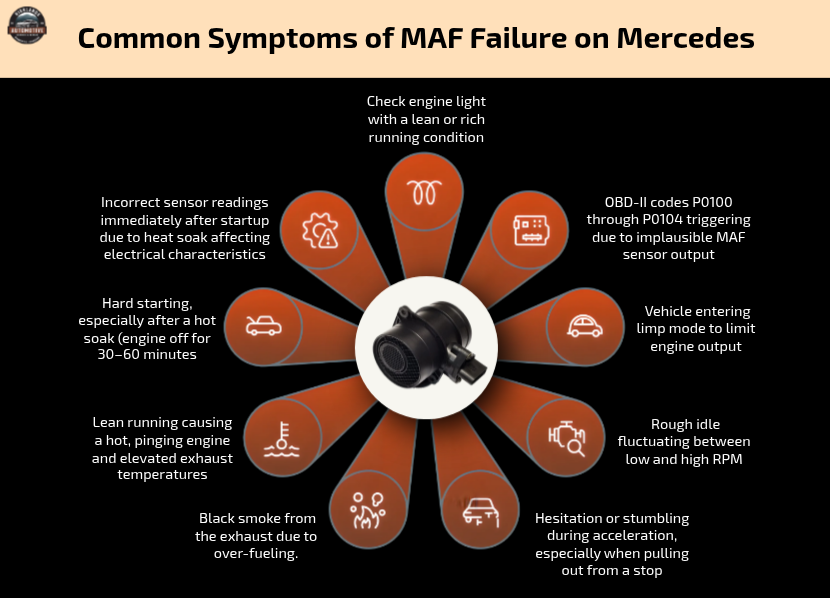
The most recognizable symptom is a check engine light accompanied by a lean or rich running condition. OBD-II codes P0100 through P0104 are all MAF-related and will trigger once the ECU determines the sensor’s output is implausible compared to other sensor data (throttle position, engine speed, manifold pressure). A Mercedes owner may also notice the car entering limp mode — a failsafe that limits engine output to prevent damage when critical sensor data is lost.
Beyond the warning light, real-world symptoms include a rough idle that may fluctuate between low and high RPM as the engine management system hunts for the correct fueling, hesitation or stumbling during acceleration, particularly when pulling out from a stop on Route 28 or the mountain roads around Highlands, and black smoke from the exhaust if the sensor is biased toward reporting low air mass (causing over-fueling). Conversely, a sensor biased toward high air mass readings causes lean running, which produces a hot, pinging engine and elevated exhaust temperatures.
Hard starting — particularly after a hot soak where the engine has been off for 30–60 minutes — is another MAF-related symptom that’s less widely recognized. Heat soak affects the sensor’s electrical characteristics in some failure modes, causing it to read incorrectly in the minutes immediately after startup when the ECU is running in closed-loop mode.
Why Mercedes MAF Sensors Fail
Contamination is the primary cause. Crankcase ventilation systems route oil vapor back into the intake stream for emissions compliance, and this vapor can coat the hot wire over thousands of miles. Air filter bypass — caused by a poorly seated or damaged air filter element — allows fine particulate to reach the sensor. Even silicon-based products used on intake boots or air filter oil on oiled-gauze performance filters can contaminate a MAF sensor.
On higher-mileage Mercedes engines, the MAF housing can develop hairline cracks that allow unmetered air to bypass the sensor entirely. This produces a consistently lean reading under load that the short-term fuel trim attempts to compensate for, eventually maxing out the trim limit and setting a fault code.
Electrical failures — damaged wiring harness insulation near the sensor connector, corroded connector pins, or a failed internal circuit board — account for the remainder of MAF failures. A connector that’s been disturbed during an air filter service and not fully reseated is a common source of intermittent MAF faults.
MAF Cleaning vs. MAF Replacement
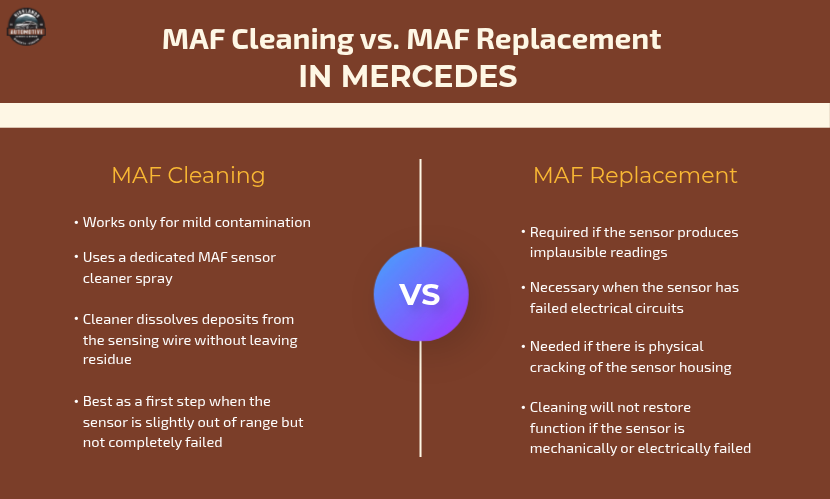
Mild contamination can sometimes be addressed with a dedicated MAF sensor cleaner spray, which dissolves deposits from the sensing wire without leaving residue. This is a legitimate first step for sensors that are reading slightly out of range but haven’t failed completely. However, a sensor that’s producing implausible readings, has failed electrical circuits, or shows physical cracking of the housing requires replacement. Attempting to clean a mechanically or electrically failed sensor will not restore function. Request an appointment online today.
Contact Highlands Automotive in Highlands, NC
If your Mercedes-Benz is showing a check engine light, running rough, or losing power, contact Highlands Automotive at (828) 787-2360 or visit us at 2851 Cashiers Rd, Highlands, NC 28741. Our ASE-certified mechanics diagnose the issue accurately and get your Mercedes running as it should.
Frequently Asked Questions
Can I drive my Mercedes with a failing MAF sensor?
If the ECU has entered limp mode, performance is severely restricted but the vehicle is drivable at reduced speeds. If the car is running rough or stumbling under hard acceleration without limp mode, continuing to drive risks lean-induced detonation damage if the engine is running hot and lean simultaneously. Prompt diagnosis is recommended.
Will cleaning the MAF sensor clear my check engine light?
Only if the sensor’s output returns to the acceptable range after cleaning and the ECU runs through its readiness cycle without logging the fault again. If the fault is due to electrical failure or physical damage, cleaning won’t help and the light will return.
How long does MAF sensor replacement take on a Mercedes?
In most cases, MAF sensor replacement on a Mercedes is a relatively simple service — 30 to 60 minutes for the part swap and clearing of fault codes. Some models have the sensor integrated into the air filter housing assembly, which adds a few minutes to the process.
Is the MAF sensor the same as the MAP sensor?
No — these are two different sensor types. A MAP (Manifold Absolute Pressure) sensor measures pressure in the intake manifold to estimate air density. A MAF sensor directly measures air mass flow at the inlet. Some engines use one or the other; some use both. Your Mercedes service records and a diagnostic scan will confirm which sensors your specific model uses.